
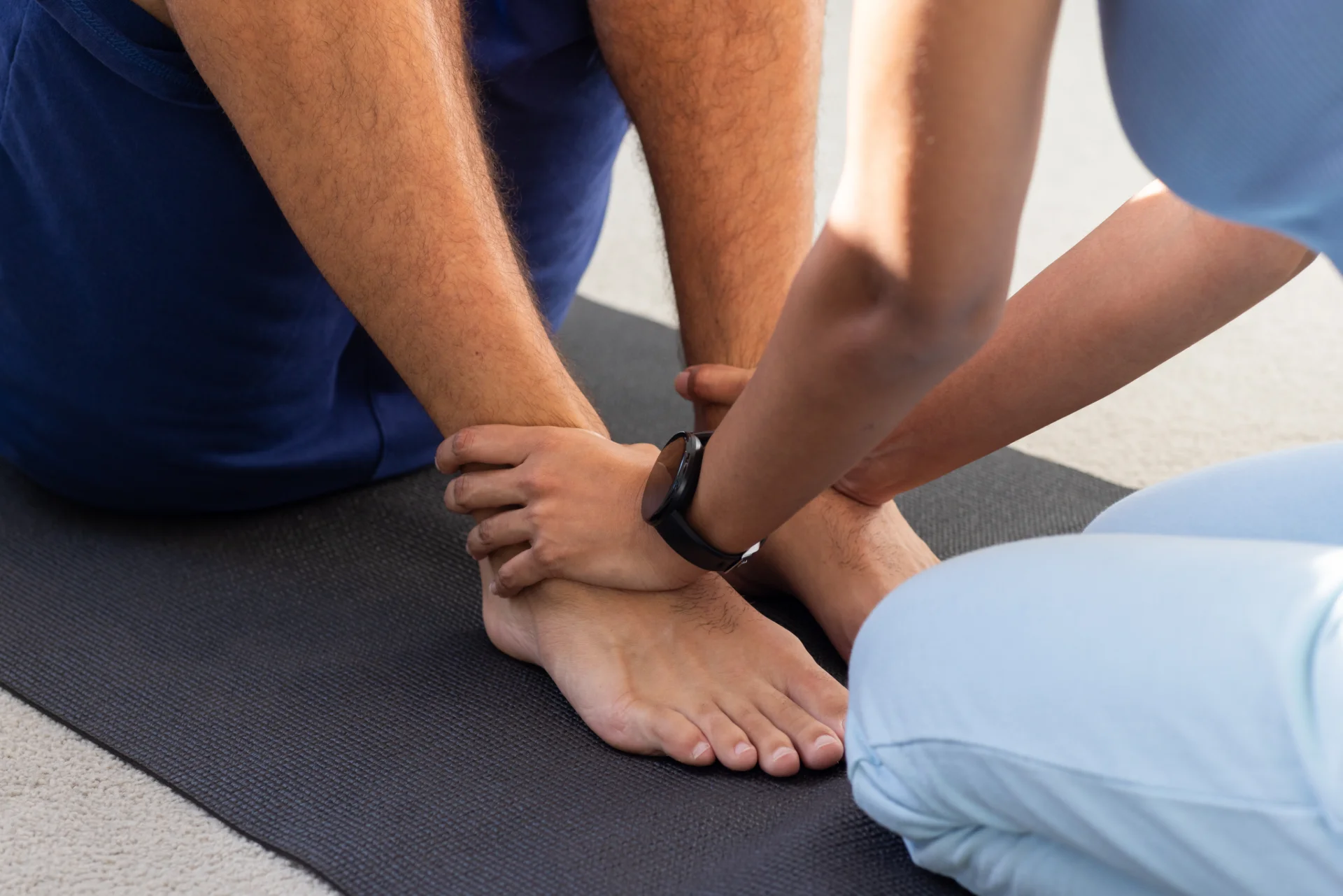
Effective Treatment for Achilles Tendon Pain
Rebuild Strength and Resilience in Your Achilles
The Achilles is the strongest tendon in the human body, but it is also one of the most frequently injured. Achilles tendinopathy causes pain, stiffness, and sometimes a noticeable thickening at the back of the heel. It is particularly common in runners, walkers, and anyone who has recently “stepped up” their activity levels.
At The Whiteley Physiotherapy Centre, we have extensive experience in treating both elite athletes and recreational walkers with Achilles pain. Our approach moves beyond simple rest; we use an evidence-based rehabilitation strategy that targets the tendon directly, addressing the root causes to ensure the pain doesn’t return the moment you increase your mileage.
Understanding Achilles Tendinopathy
What is Achilles Tendinopathy?
Contrary to old-fashioned labels like “tendonitis,” this is not usually an inflammatory condition. Instead, it is a failed healing response where the tendon has been overloaded and has struggled to repair itself correctly.
- Midportion Tendinopathy: Affects the middle of the tendon (2–6cm above the heel). This is the most common form.
- Insertional Tendinopathy: Affects the point where the tendon attaches directly to the heel bone. This often requires a slightly different approach to exercise and footwear.
Common Causes
Tendons love consistency. They typically become painful when subjected to a “spike” in load that they aren’t prepared for. This might be a sudden increase in running distance, a change in training surface (moving from grass to road), or wearing flat shoes after being used to a heel. Calf weakness and poor ankle mobility often play a silent but significant role in this overload.
Symptoms to Look Out For
- Morning Stiffness: A “hobbling” sensation during your first few steps out of bed.
- The “Warm-up” Effect: Pain that feels better once you start moving but returns with a vengeance after you stop.
- Tenderness: The tendon feels sore to the touch or appears thickened and “bumpy.”
How We Treat Achilles Pain
- Progressive Tendon Loading: This is the “gold standard” of treatment. We prescribe specific, heavy slow-resistance exercises (such as eccentric calf raises) that stimulate the tendon to remodel and get stronger.
- Focused Shockwave Therapy: For chronic cases that haven’t settled after three months of exercise, Shockwave Therapy is a highly effective, non-invasive option available at our Whiteley clinic to “re-start” the healing process.
- Biomechanical & Gait Assessment: We look at how you move. If your running technique or walking mechanics are placing uneven stress on the tendon, we provide practical cues to “quieten” that load.
- Integrated Podiatry: Where foot structure is a major factor, our on-site Podiatry service can provide expert orthotic assessment to support your recovery.
- Manual Therapy: We use soft tissue work on the calf muscles and joint mobilisations of the ankle to ensure your “mechanical chain” is moving fluidly.
Your First Appointment
At The Whiteley Physiotherapy Centre, we know that Achilles pain can be incredibly restrictive. Your first session is about moving from “managing” the pain to actively fixing the problem.
Practicalities for your visit:
- A Detailed 45-Minute Assessment: Your clinician will assess your tendon health, calf power, and foot biomechanics to create a bespoke “loading” roadmap.
- What to wear: Please wear shorts and bring the trainers or shoes you wear most frequently for exercise.
- What to bring: If you have used heel raises, orthotics, or previous scan results, please bring them along.
- Immediate Action: You will leave with a clear understanding of your diagnosis and your first set of strengthening exercises to begin immediately.
Honesty in Recovery
We believe in realistic expectations. Tendons are among the slowest tissues in the body to adapt because they have a limited blood supply.
Clinical Note: There are no short-cuts with a symptomatic tendon. It takes time for the internal “scaffolding” of the Achilles to remodel.
Most patients require a minimum of twelve weeks of consistent rehabilitation to see a significant, lasting change in tendon health. We will be honest about this timeline from the start; while we can often reduce your pain quite quickly, the “heavy lifting” of making the tendon resilient again requires patience and persistence. Our goal is to ensure that when you return to the hills or the track, your Achilles is stronger than it was before the injury started.
Your Treatment Team
- Yves De Vos – Physiotherapist and shockwave therapy (CSP: 54623 | HCPC: PH48182)
- Cameron Hawley – Sports therapist and shockwave therapy (SST: 22983)
- Felicia Fetcu – Physiotherapist (CSP: 106027 | HCPC: PH117618)
- Bethany Vance – Physiotherapist (CSP: 127691 | HCPC: PH146896)
- Neil Duncan – Sports therapist (SST: 25529)
Pricing and Appointment
-
Initial Assessment £79 / 45 minutes
-
Follow-Up Session £59 / 30 minutes
-
Block Booking £319 for 6 sessions
We are recognised by Bupa, AXA PPP, Aviva, WPA, Cigna, and Vitality.
To book, call 01489 569888 or email info@thewhiteleyphysiocentre.co.uk.
Conveniently Located in Whiteley
Our clinic is at Gull Coppice, Yew Tree Drive, Whiteley, Fareham, Hampshire, PO15 7LS. We serve patients from Whiteley, Fareham, Segensworth, Swanwick, Titchfield, Sarisbury, and Burridge.
Phone: 01489 569888
Email: info@thewhiteleyphysiocentre.co.uk
Frequently Asked Questions
How long does Achilles tendinopathy take to recover?
Most patients need a minimum of twelve weeks of consistent rehabilitation. Some complex cases take longer. Your clinician will be upfront about timescales.
Should I rest completely?
No. Complete rest can actually weaken the tendon further. The key is to modify your activity to a level the tendon can tolerate, while following a progressive loading programme. Your clinician will guide you on this.
Can I still run with Achilles tendinopathy?
This depends on your symptoms. Some patients can continue running at a reduced volume, while others need a temporary break. Your clinician will advise based on your assessment.
What are eccentric exercises?
Eccentric exercises involve slowly lowering a weight, in this case lowering your heel over the edge of a step. They are one of the most evidence-based treatments for Achilles tendinopathy.
Will shockwave therapy help?
Shockwave therapy is supported by evidence for chronic Achilles tendinopathy that has not responded to three months of exercise-based rehabilitation. It is not usually a first-line treatment.
Do I need a scan?
In most cases, your clinician can diagnose Achilles tendinopathy clinically. If imaging is needed, our on-site diagnostic ultrasound can assess the tendon directly.
Can orthotics help?
In some cases, yes. If foot biomechanics are contributing to your tendinopathy, our podiatry service can assess whether orthotics would be beneficial.
Is Achilles tendinopathy the same as a ruptured Achilles?
No. Tendinopathy is a painful but intact tendon. A rupture is a complete or partial tear, which usually presents with sudden severe pain and inability to push off on the foot. If you suspect a rupture, seek urgent medical assessment.
Is treatment covered by insurance?
Yes. Physiotherapy for Achilles tendinopathy is typically covered. We are recognised by Bupa, AXA PPP, Aviva, WPA, Cigna, and Vitality.
How do I book?
Ready to Get Started?
Achilles pain holding you back? Call 01489 569888 to book your assessment and start treatment.