
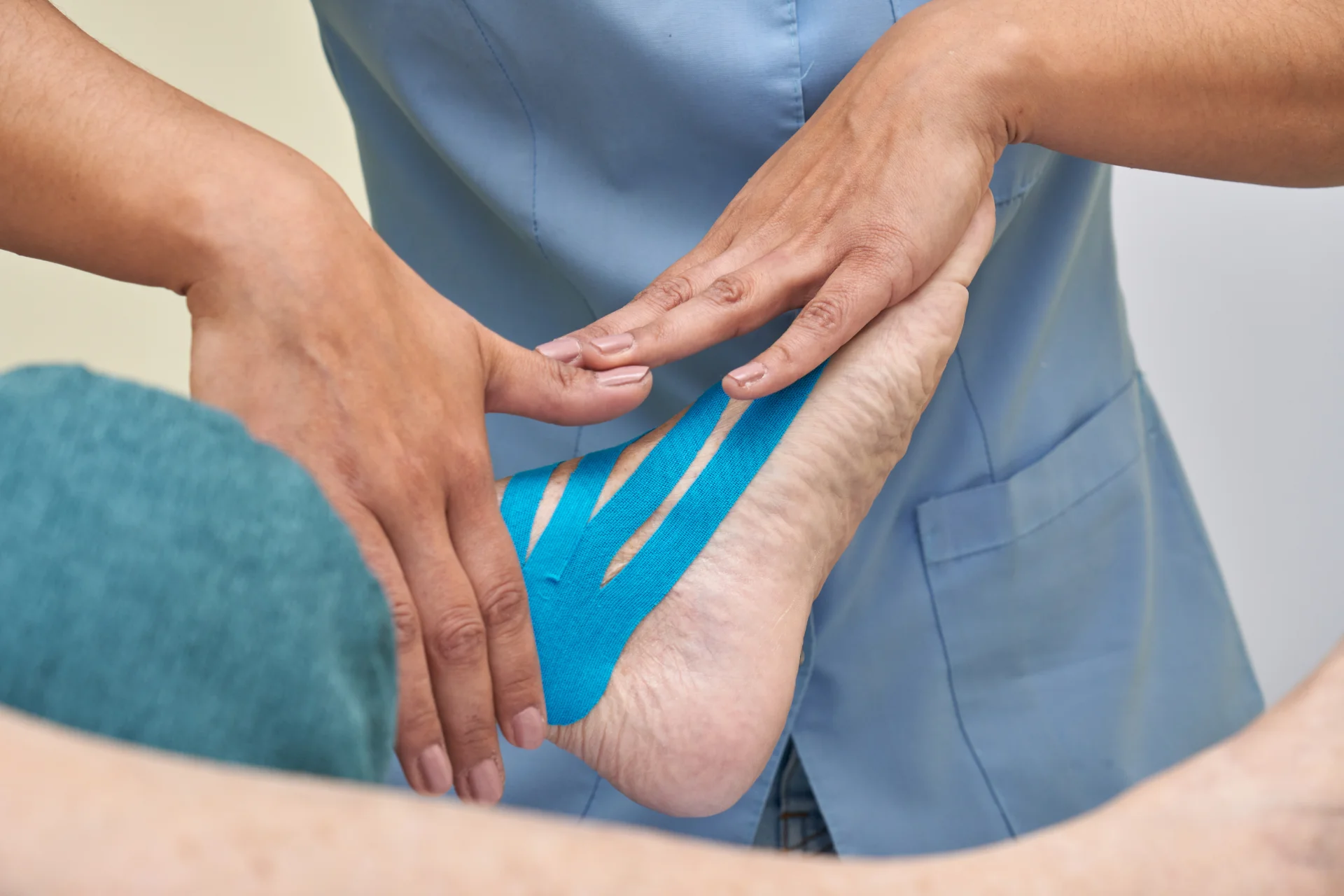
Effective Treatment for Ankle Sprains
Recover Fully and Prevent Re-Injury
Ankle sprains are among the most common musculoskeletal injuries, yet they are frequently underestimated. A sprain occurs when the ligaments supporting the ankle are overstretched or torn—usually following a sudden twist, a stumble, or an awkward landing.
While many people dismiss a sprained ankle as a “minor” niggle, inadequate rehabilitation is the leading cause of chronic weakness and instability. At The Whiteley Physiotherapy Centre, we believe in treating ankle sprains properly from day one. Whether your injury happened yesterday or months ago, our team of physiotherapists and sports therapists will help you rebuild the strength and confidence your ankle needs to stay stable.
Understanding Ankle Sprains
What Happens During a Sprain?
Most commonly, the foot rolls inward, overstretching the ligaments on the outside of the joint (a lateral ankle sprain). This triggers immediate pain, swelling, and often bruising. You may find it difficult to bear weight, or feel as though the ankle is “giving way.”
The Three Grades of Severity
- Grade 1 (Mild): Micro-tears or stretching of the ligament. Expect minor swelling and a quick return to activity.
- Grade 2 (Moderate): A partial tear of the ligament. This involves significant swelling, bruising, and some joint laxity (looseness).
- Grade 3 (Severe): A complete rupture of the ligament. This results in intense swelling and a joint that feels unstable.
Why Professional Rehab is Vital
Research indicates that up to 40% of people who suffer an ankle sprain go on to develop Chronic Ankle Instability. This means the ankle continues to feel weak and “gives way” during sports or even walking on uneven ground. This cycle of re-injury is almost always preventable with a rehabilitation programme that restores not just strength, but your body’s internal “balance sensors.”
How We Treat Ankle Sprains
- Acute Phase Management: In the first few days, we focus on controlling pain and swelling while protecting the healing tissue. We move beyond simple “rest” to introduce early, safe mobilisation that prevents the joint from “freezing up.”
- Progressive Strengthening: Once the initial pain settles, we target the muscles that wrap around the ankle—specifically the peroneal muscles. Strengthening these acts like an internal stirrup, providing active support to the joint.
- Proprioception (Balance) Training: This is the most critical phase of recovery. After a sprain, your brain’s ability to “sense” where your ankle is in space is disrupted. We use specific balance drills to retrain these neural pathways, which is the single most effective way to prevent future sprains.
- Sport-Specific Agility: For our active patients in Whiteley and Fareham, we progress to hopping, jumping, and change-of-direction drills. We ensure your ankle can handle the “peak loads” of your sport before you return to full training.
Your First Appointment
At The Whiteley Physiotherapy Centre, we recommend early assessment. You do not need to wait for the swelling to go down before booking; in fact, early advice can often shorten your total recovery time.
Practicalities for your visit:
- A Comprehensive 45-Minute Assessment: Your clinician will test your ligament stability, muscle strength, and range of motion to accurately “grade” your injury.
- What to wear: Please wear shorts and bring the footwear you were wearing when the injury occurred (if applicable), as well as your usual sports shoes.
- Immediate Strategy: You will leave with a clear diagnosis, a plan for managing the swelling, and your first set of “rehab” exercises to begin immediately.
Honesty in Recovery
We believe in realistic expectations. While a Grade 1 sprain might feel “back to normal” in two weeks, the underlying ligaments often take longer to fully mature and strengthen.
Clinical Note: Pain is often the first thing to disappear, but balance and strength are the last things to return.
If you return to high-impact sport the moment the pain stops without finishing your balance training, the risk of a repeat sprain is significantly higher. Most patients require four to eight weeks of structured rehabilitation to achieve a “bulletproof” ankle. Our goal is to ensure that when you head back out onto the pitch or the pavement, you do so with total confidence in your stability.
Your Treatment Team
- Felicia Fetcu – Physiotherapist (CSP: 106027 | HCPC: PH117618)
- Bethany Vance – Physiotherapist (CSP: 127691 | HCPC: PH146896)
- Yves De Vos – Physiotherapist (CSP: 54623 | HCPC: PH48182)
- Cameron Hawley – Sports therapist (SST: 22983)
- Neil Duncan – Sports therapist (SST: 25529)
Pricing and Appointment
-
Initial Assessment £79 / 45 minutes
-
Follow-Up Session £59 / 30 minutes
-
Block Booking £319 for 6 sessions
We are recognised by Bupa, AXA PPP, Aviva, WPA, Cigna, and Vitality.
To book, call 01489 569888 or email info@thewhiteleyphysiocentre.co.uk.
Conveniently Located in Whiteley
Our clinic is at Gull Coppice, Yew Tree Drive, Whiteley, Fareham, Hampshire, PO15 7LS. We serve patients from Whiteley, Fareham, Segensworth, Swanwick, Titchfield, Sarisbury, and Burridge.
Phone: 01489 569888
Email: info@thewhiteleyphysiocentre.co.uk
Frequently Asked Questions
Should I go to A&E or see a physiotherapist?
If you cannot bear any weight on your ankle, suspect a fracture, or have significant deformity, go to A&E for an X-ray first. If you can take some weight and the main symptoms are pain, swelling, and stiffness, a physiotherapy assessment is the right starting point.
How soon after a sprain should I start physiotherapy?
As soon as possible. Early treatment can speed up recovery and reduce the risk of long-term problems. You do not need to wait for swelling to settle.
Do I need an X-ray?
Not always. Your physiotherapist can assess whether an X-ray is needed based on clinical guidelines. If a fracture is suspected, they will refer you for imaging.
How long does an ankle sprain take to heal?
A mild sprain may recover in two to four weeks. A moderate sprain typically takes four to eight weeks. A severe sprain can take three months or more. Full rehabilitation, including balance and strengthening work, is important regardless of the grade.
Can I still exercise with a sprained ankle?
You will need to modify your activity in the early stages, but your physiotherapist will keep you as active as possible. Upper body exercise, cycling, and swimming are often suitable alternatives while your ankle recovers.
Why does my ankle keep spraining?
Recurrent sprains are usually caused by incomplete rehabilitation, particularly a lack of balance and proprioception training. Our rehabilitation programme is specifically designed to address this.
Will I need a brace or support?
Possibly in the short term, depending on the severity of your sprain. Your physiotherapist will advise on whether a brace, taping, or support is appropriate.
Is ankle sprain treatment covered by insurance?
Yes. Physiotherapy for ankle sprains is typically covered. We are recognised by Bupa, AXA PPP, Aviva, WPA, Cigna, and Vitality.
Do I need a referral?
No. You can book directly.
How do I book?
Ready to Get Started?
Sprained your ankle? Call 01489 569888 to book your assessment and start treatment.