
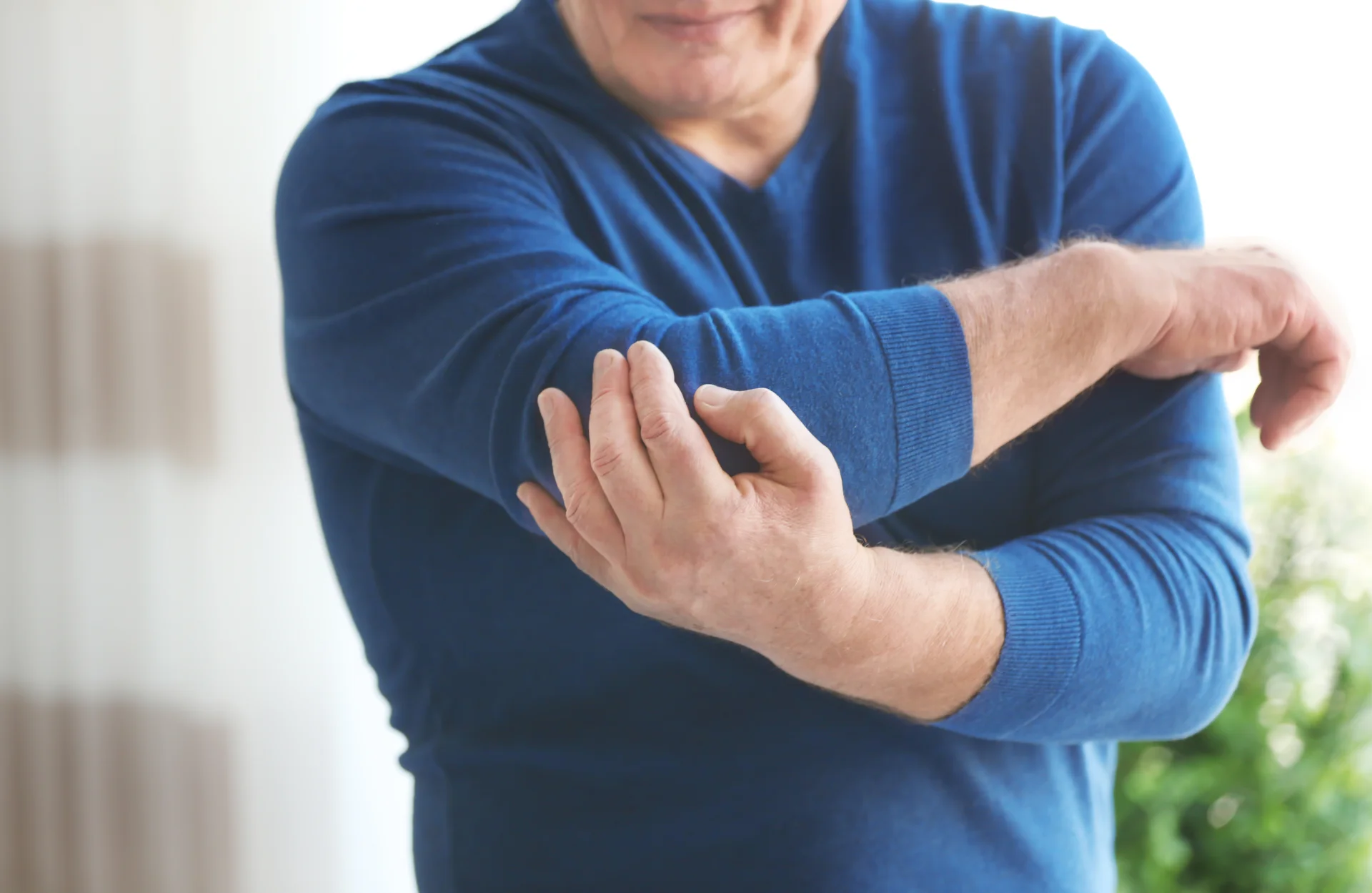
Effective Treatment for Elbow Pain
Tennis elbow, known clinically as lateral epicondylalgia, causes persistent pain on the outside of the elbow. Despite its name, it is far more common in people who have never picked up a racquet. Repetitive gripping, typing, heavy lifting, and manual work are the usual culprits. Golfer’s elbow, its counterpart on the inside of the elbow, is caused by similar overload patterns where the tendons struggle to keep up with the demands placed upon them.
At The Whiteley Physiotherapy Centre, we treat tennis and golfer’s elbow regularly. Our clinicians move beyond simple “rest and ice” to provide an evidence-based rehabilitation approach. We focus on progressive tendon loading, combined with targeted hands-on treatment and, where clinically indicated, Shockwave Therapy to kick-start the healing process in stubborn cases.
Understanding Tennis Elbow
What Is Tennis Elbow?
Tennis elbow involves pain and dysfunction in the tendons that attach to the bony prominence on the outside of your arm. These tendons connect the forearm extensor muscles, which are responsible for gripping, twisting, and lifting. When these tendons are overloaded repeatedly—often through “too much, too soon”—they develop a painful, degenerative response rather than a simple inflammation.
Golfer’s elbow is the equivalent condition on the inside of the elbow, affecting the flexor tendons that help you curl your wrist and grasp objects.
Common Causes
- Repetitive Gripping: Squeezing or holding objects, particularly with a straightened elbow.
- Workplace Strain: Prolonged computer and mouse use or manual trades involving tools.
- Sporting Load: Racquet sports (often linked to poor technique) or a sudden increase in gym volume.
- Home Life: Intensive DIY, gardening, decorating, or lifting heavy shopping bags.
Symptoms
- Localised Pain: Sharpness or an ache on the outside (Tennis) or inside (Golfer’s) of the joint.
- Functional Difficulty: Pain when turning a door handle, shaking hands, or lifting a kettle.
- Reduced Grip: A noticeable weakness when trying to hold or carry objects.
- Radiation: Discomfort that may travel down into the forearm or up towards the shoulder.
- Tenderness: The bony point of the elbow feels bruised or highly sensitive to touch.
How We Treat Tennis Elbow
Progressive Tendon Loading
Like other tendinopathies, structured loading exercises are the most effective way to recover. We prescribe specific strengthening drills for the forearm, starting at a manageable level and building gradually. This “tells” the tendon to repair and adapt, making it more resilient to the stresses of your daily life.
Manual Therapy
Hands-on techniques—including soft tissue massage and joint mobilisations of the elbow and wrist—can provide vital pain relief. We also assess your neck (cervical spine) and upper back, as stiffness in these areas can often contribute to or even mimic elbow symptoms.
Activity Modification
Total rest is rarely the answer for a tendon. Your clinician will help you identify which specific movements are “spiking” your pain and suggest practical modifications. This allows you to stay active while your rehabilitation takes effect.
Shockwave Therapy
For tennis elbow that has persisted beyond three months despite exercise, Shockwave Therapy is an excellent, well-evidenced option. It delivers mechanical energy to the tissue, stimulating blood flow and re-triggering the body’s natural healing response.
Bracing
A forearm “clasp” brace can be useful to “offload” the tendon during aggravating tasks. While not a standalone cure, it can provide helpful short-term support to get you through the workday alongside your rehab.
What to Expect at Your First Appointment
At The Whiteley Physiotherapy Centre, we understand that persistent elbow pain can make the simplest daily tasks—from picking up a kettle to using a computer mouse—feel like a significant hurdle. Our goal is to move you beyond “managing” the pain and start rebuilding the strength your tendons need to function without irritation.
Practicalities for your visit:
- A Comprehensive Assessment: Your initial appointment lasts 45 minutes. This allows your physiotherapist to look beyond just the elbow joint, assessing your wrist, forearm, and even your neck to ensure we’ve identified the true source of your symptoms.
- What to wear: Please wear a short-sleeved top or a vest that allows easy access to your arm from the shoulder down to the wrist.
- What to bring: If you have used any elbow braces, supports, or ergonomic equipment (like a vertical mouse or keyboard), please bring them along or take a photo so we can review their effectiveness.
- Immediate Insight: You won’t leave with just a diagnosis. Your clinician will explain your condition in plain English and provide you with a tailored loading programme and activity modification advice to begin your recovery from day one.
Honesty in Recovery
We believe in realistic expectations. Tendons are notoriously slow to heal because they have a limited blood supply compared to muscles. Recovery from a chronic “Tennis” or “Golfer’s” elbow is rarely an overnight fix.
Clinical Note: Unlike a simple muscle strain that might settle in a fortnight, a symptomatic tendon requires a physiological change in its structure.
Most patients begin to feel a meaningful reduction in pain and an increase in grip strength within six to twelve weeks of consistent, progressive loading. While hands-on treatment and Shockwave Therapy can significantly speed up the process and provide relief, the “heavy lifting” is done through your exercise programme. Our role is to guide you through that progression, ensuring you don’t do “too much, too soon,” but just enough to ensure your elbow becomes more resilient than it was before the injury.
Your Treatment Team
- Yves De Vos – Physiotherapist and shockwave therapy (CSP: 54623 | HCPC: PH48182)
- Cameron Hawley – Sports therapist and shockwave therapy (SST: 22983)
- Felicia Fetcu – Physiotherapist (CSP: 106027 | HCPC: PH117618)
- Bethany Vance – Physiotherapist (CSP: 127691 | HCPC: PH146896)
- Simona Jacob – Physiotherapist (CSP: 111102 | HCPC: PH124185)
Pricing and Appointment
-
Initial Assessment £79 / 45 minutes
-
Follow-Up Session £59 / 30 minutes
-
Block Booking £319 for 6 sessions
We are recognised by Bupa, AXA PPP, Aviva, WPA, Cigna, and Vitality.
To book, call 01489 569888 or email info@thewhiteleyphysiocentre.co.uk.
Conveniently Located in Whiteley
Our clinic is at Gull Coppice, Yew Tree Drive, Whiteley, Fareham, Hampshire, PO15 7LS. We serve patients from Whiteley, Fareham, Segensworth, Swanwick, Titchfield, Sarisbury, and Burridge.
Phone: 01489 569888
Email: info@thewhiteleyphysiocentre.co.uk
Frequently Asked Questions
How long does tennis elbow take to recover?
With consistent rehabilitation, most patients see significant improvement within six to twelve weeks. Some stubborn cases take longer. Early treatment generally leads to faster recovery.
Do I need to stop using my arm?
Not completely. Avoiding the specific activities that aggravate your tendon is important, but complete rest can slow recovery. Your clinician will help you find the right balance.
Will a steroid injection help?
Steroid injections can provide short-term relief, but research shows that outcomes at six to twelve months are often worse than with exercise-based rehabilitation alone. Your clinician will discuss all options with you.
Is shockwave therapy effective for tennis elbow?
Yes. Shockwave therapy is well supported by evidence for chronic tennis elbow. It is typically recommended when the condition has persisted for at least three months.
Can tennis elbow be caused by computer work?
Yes. Prolonged mouse use and repetitive keyboard work are common contributors, particularly when combined with a poor desk setup. Your clinician can advise on ergonomic adjustments.
Is it really tennis elbow if I don't play tennis?
Yes. The name is misleading. The vast majority of tennis elbow cases are caused by everyday activities and occupational tasks rather than racquet sports.
Should I use a brace?
A forearm clasp brace can help offload the tendon during aggravating activities. It is best used as a short-term support alongside your rehabilitation programme.
Can the neck cause elbow pain?
Yes. Cervical spine stiffness can refer pain into the elbow and forearm. We always assess the neck as part of an elbow examination.
Is treatment covered by insurance?
Yes. We are recognised by Bupa, AXA PPP, Aviva, WPA, Cigna, and Vitality.
How do I book?
Ready to Get Started?
Elbow pain making daily tasks difficult? Call 01489 569888 to book your assessment and get your recovery underway.